
Suppose we want to do arithmetic with rational numbers. We want to be able to add, subtract, multiply, and divide them and to test whether two rational numbers are equal.
Let us begin by assuming that we already have a way of constructing a rational number from a numerator and a denominator. We also assume that, given a rational number, we have a way of extracting (or selecting) its numerator and its denominator. Let us further assume that the constructor and selectors are available as procedures:
We are using here a powerful strategy of synthesis: wishful thinking. We haven't yet said how a rational number is represented, or how the procedures numer, denom, and make-rat should be implemented. Even so, if we did have these three procedures, we could then add, subtract, multiply, divide, and test equality by using the following relations:
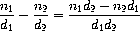



We can express these rules as procedures:
(define (add-rat x y)
(make-rat (+ (* (numer x) (denom y))
(* (numer y) (denom x)))
(* (denom x) (denom y))))
(define (sub-rat x y)
(make-rat (- (* (numer x) (denom y))
(* (numer y) (denom x)))
(* (denom x) (denom y))))
(define (mul-rat x y)
(make-rat (* (numer x) (numer y))
(* (denom x) (denom y))))
(define (div-rat x y)
(make-rat (* (numer x) (denom y))
(* (denom x) (numer y))))
(define (equal-rat? x y)
(= (* (numer x) (denom y))
(* (numer y) (denom x))))
Now we have the operations on rational numbers defined in terms of the selector and constructor procedures numer, denom, and make-rat. But we haven't yet defined these. What we need is some way to glue together a numerator and a denominator to form a rational number.
To enable us to implement the concrete level of our data abstraction, our language provides a compound structure called a pair, which can be constructed with the primitive procedure cons. This procedure takes two arguments and returns a compound data object that contains the two arguments as parts. Given a pair, we can extract the parts using the primitive procedures car and cdr.noteThe name cons stands for "construct." The names car and cdr derive from the original implementation of Lisp on the IBM 704. That machine had an addressing scheme that allowed one to reference the "address" and "decrement" parts of a memory location. Car stands for "Contents of Address part of Register" and cdr (pronounced "could-er") stands for "Contents of Decrement part of Register." Thus, we can use cons, car, and cdr as follows:
(define x (cons 1 2))
(car x)
1
(cdr x)
2
Notice that a pair is a data object that can be given a name and manipulated, just like a primitive data object. Moreover, cons can be used to form pairs whose elements are pairs, and so on:
(define x (cons 1 2))
(define y (cons 3 4))
(define z (cons x y))
(car (car z))
1
(car (cdr z))
3
In section 2.2 we will see how this ability to combine pairs means that pairs can be used as general-purpose building blocks to create all sorts of complex data structures. The single compound-data primitive pair, implemented by the procedures cons, car, and cdr, is the only glue we need. Data objects constructed from pairs are called list-structured data.
Pairs offer a natural way to complete the rational-number system. Simply represent a rational number as a pair of two integers: a numerator and a denominator. Then make-rat, numer, and denom are readily implemented as follows:noteAnother way to define the selectors and constructor is (define make-rat cons) (define numer car) (define denom cdr) The first definition associates the name make-rat with the value of the expression cons, which is the primitive procedure that constructs pairs. Thus make-rat and cons are names for the same primitive constructor. Defining selectors and constructors in this way is efficient: Instead of make-rat calling cons, make-rat is cons, so there is only one procedure called, not two, when make-rat is called. On the other hand, doing this defeats debugging aids that trace procedure calls or put breakpoints on procedure calls: You may want to watch make-rat being called, but you certainly don't want to watch every call to cons. We have chosen not to use this style of definition in this book.
(define (make-rat n d) (cons n d))
(define (numer x) (car x))
(define (denom x) (cdr x))
Also, in order to display the results of our computations, we can print rational numbers by printing the numerator, a slash, and the denominator:noteDisplay is the Scheme primitive for printing data. The Scheme primitive newline starts a new line for printing. Neither of these procedures returns a useful value, so in the uses of print-rat below, we show only what print-rat prints, not what the interpreter prints as the value returned by print-rat.
(define (print-rat x)
(newline)
(display (numer x))
(display "/")
(display (denom x)))
Now we can try our rational-number procedures:
(define one-half (make-rat 1 2))
(print-rat one-half)
1/2
(define one-third (make-rat 1 3))
(print-rat (add-rat one-half one-third))
5/6
(print-rat (mul-rat one-half one-third))
1/6
(print-rat (add-rat one-third one-third))
6/9
As the final example shows, our rational-number implementation does not reduce rational numbers to lowest terms. We can remedy this by changing make-rat. If we have a gcd procedure like the one in section 1.2.5 that produces the greatest common divisor of two integers, we can use gcd to reduce the numerator and the denominator to lowest terms before constructing the pair:
(define (make-rat n d)
(let ((g (gcd n d)))
(cons (/ n g) (/ d g))))
Now we have
(print-rat (add-rat one-third one-third))
2/3
as desired. This modification was accomplished by changing the constructor make-rat without changing any of the procedures (such as add-rat and mul-rat) that implement the actual operations.